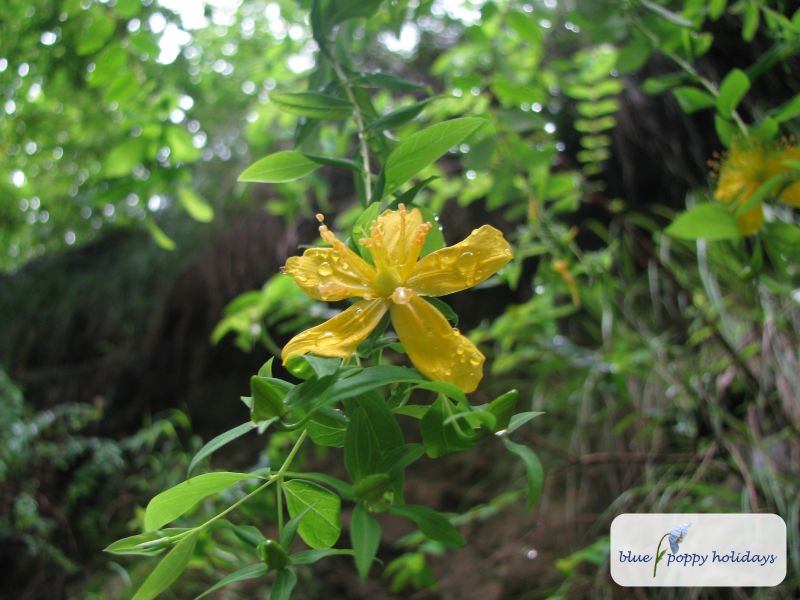
Wildflower of the valley
Perforate St John's Wort, Common St John's Wort
Hypericum perforatum
- Family
- Hypericaceae (St. John's wort family)
- Local name
- Choli phulya (Hindi) · Vettai pakku (Tamil)
- Type
- Erect perennial herb
- Height
- 20–50 cm
- Altitude
- 1200–2400 m
- Flower colour
- Bright yellow to yellow-orange
- Flowering
- May to August
About Perforate St John's Wort, Common St John's Wort
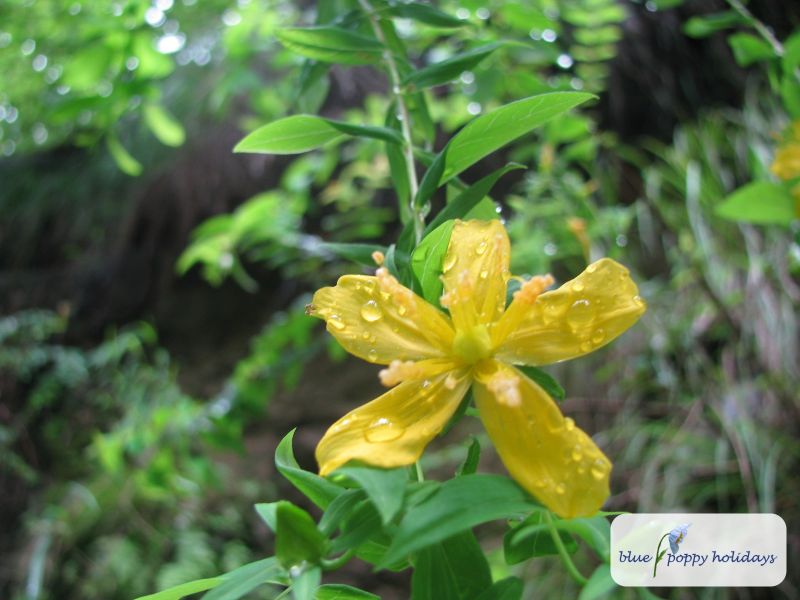
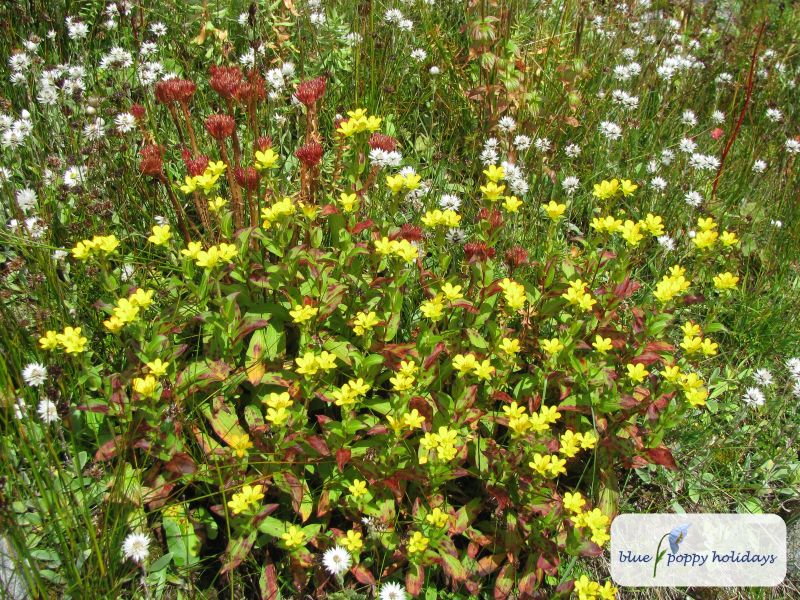
Perforate St John's Wort is an erect perennial herb of 20 to 50 cm, growing from a shallow rhizome. The stem is unbranched at the base and characteristically rounded — a small detail that separates it from most of its neighbours in the family, which have square or ridged stems. The paired, lance-shaped leaves clasp the stem and, when held to the light, appear pinpricked with translucent dots. Despite the name perforatum, these are not holes at all: each dot is a small colourless gland packed with essential oils and resin, and it is these that give the leaf its "perforated" impression.
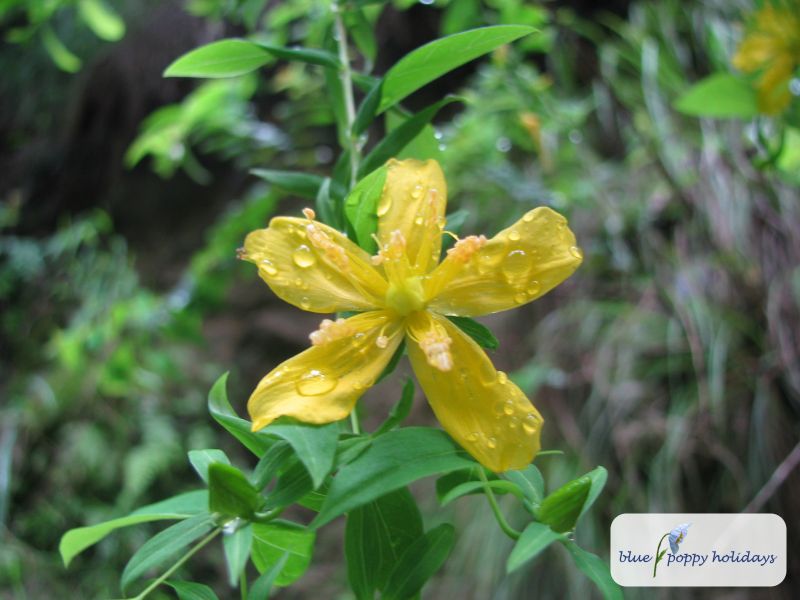
The flowers gather in a branched cluster at the top of the stem — bright yellow to yellow-orange, five-petalled, and studded around the petal margins with tiny black dots. When these black dots are rubbed between the fingertips they release a rich red-purple stain, one of the plant's classic field-identification tests. The stamens are numerous, gathered into three or five bundles; the ovary carries three styles.
It flowers from May through August, and is found across the western Himalaya at altitudes of roughly 1200 to 2400 metres — a lower-elevation companion to the higher-altitude Hypericum species. The plant is now cultivated commercially in several parts of India for the pharmaceutical trade in hypericin extracts.
Habitat
Open slopes, roadside banks and disturbed ground in the middle Himalaya.
Uses & folklore
An old European medicinal plant now firmly established across the Himalayan mid-hills. The oil pressed from its fresh flowers, when steeped in olive oil, has been used externally for sores, wounds, ulcers and skin swellings for centuries; the same oil is a favoured ingredient in sunburn preparations and in hair-restorer formulations. Modern research has identified hypericin — one of the compounds responsible for the red staining when the black-dotted petals are rubbed — as a mild antidepressant, and Hypericum perforatum is now cultivated commercially across parts of Europe and India for this trade. A caution nonetheless: the plant increases photosensitivity in some people, and standardised preparations interact with a number of prescribed medicines.
What the name means
Hypericum comes from the Greek hyper ("above") + eikon ("image"), from the ancient practice of hanging sprigs of the plant above icons and doorways on Midsummer's Eve to ward off evil spirits and lightning. The species name perforatum is Latin for "perforated", after the appearance of the leaves when held to the light — a translucent-dot pattern that seems to pinprick them through.
Don't confuse it with
Hypericum oblongifolium (sno 144) is the other St John's wort in this collection — a taller, more shrubby species with oblong (not lance-shaped) leaves that do not show the translucent dots so clearly. H. perforatum is set apart by its perforated-looking leaves, rounded stems, black-dotted petal margins and the red stain released when those dots are crushed.