Wildflower of the valley
Himalayan Alpine Arum
Sauromatum diversifolium
- Family
- Araceae (Arum family)
- Local name
- NOT AVAILABLE
- Type
- Tuberous perennial herb
- Height
- 15–35 cm
- Altitude
- 2800–4200 m
- Flower colour
- Maroon and green (spathe)
- Flowering
- June to August
About Himalayan Alpine Arum
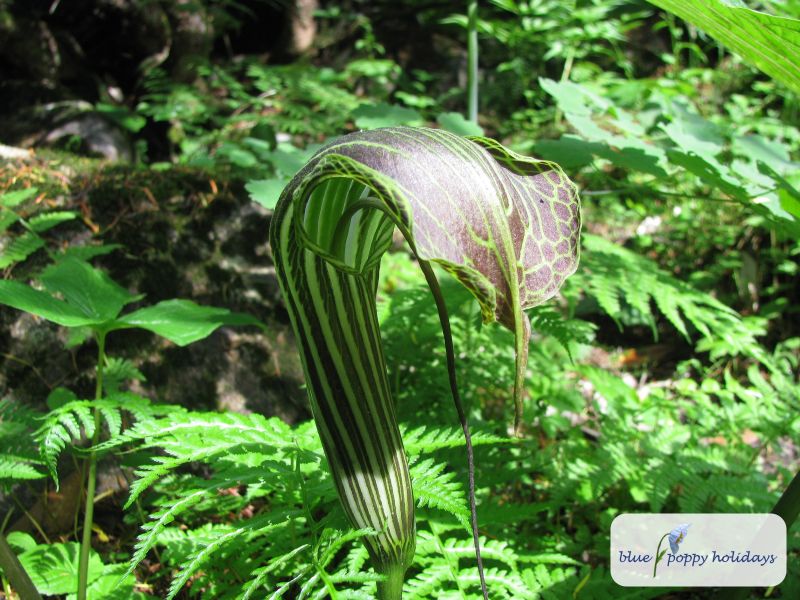
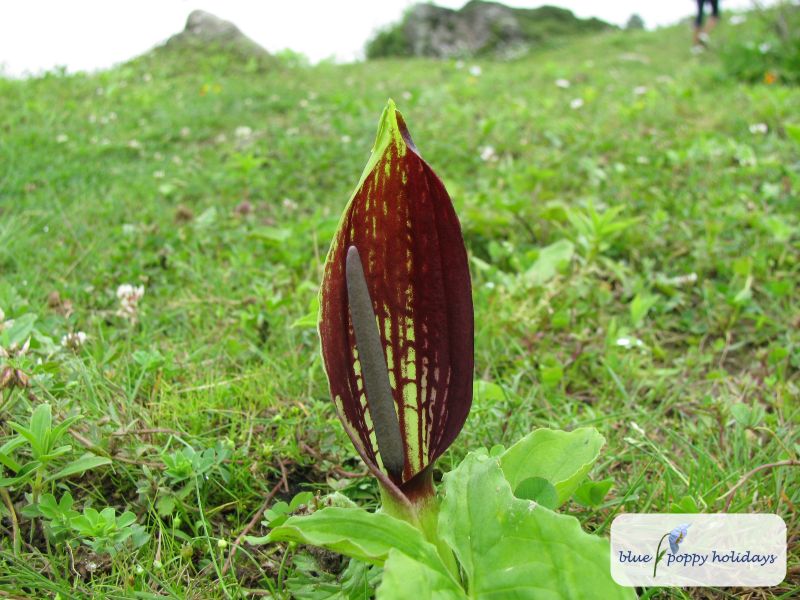
Sauromatum diversifolium is a small alpine aroid, and — like all its family — what looks at first glance like a single flower is nothing of the kind. The whole showy structure is an inflorescence: a hooded leaf called a spathe, mottled maroon and green, wraps protectively around a dark, rod-like central spike called the spadix, on which the true, tiny flowers are packed. The impression is of something between a cobra's hood and an unfurled monk's cowl.
The plant grows from a small, rounded underground tuber which stores enough energy to send the inflorescence up quickly each summer, often ahead of the accompanying leaves. The leaves themselves — which appear later in the season and are strikingly different from the flowering structure, hence the name diversifolium — are palmately divided, deep green, and held up on their own long petioles well after the spathe has withered.
Its pollination biology is a small piece of botanical theatre. The plant emits an unmistakable scent — often described as reminiscent of dung or decaying flesh — that lures in beetles and flies looking for a corpse in which to lay their eggs. Once these insects crawl down inside the smooth-walled spathe tube, they find themselves temporarily trapped. Overnight the plant releases pollen onto them. Only in the morning, when the pollen is safely applied, do the spathe walls slacken and let the deceived pollinators escape — carrying pollen to the next flowering plant, which repeats the trick.
It was until recently classified in the genus Typhonium. Modern molecular work has moved several species — this one included — into Sauromatum.
Habitat
Alpine slopes, open grassy meadows and forest understorey — often appearing during the monsoon.
What the name means
Sauromatum is derived from the Greek sauros ("lizard") — after the mottled lizard-skin patterning of the spathe interior in the type species. The specific epithet diversifolium is Latin — diversus (varied, different) + folium (leaf) — recording the plant's unusual habit of producing two very differently-shaped kinds of foliage: the small scale-like bracts of the flowering stalk, followed later in the season by the strongly dissected true leaves.
Don't confuse it with
The three Arisaema species in this book — A. propinquum (sno 68), A. jacquemontii (sno 69) and A. tortuosum (sno 70), the "cobra lilies" of the Valley of Flowers — are its closest relatives in this collection and share the family's hooded spathe-and-spadix architecture. They differ mainly in scent (Arisaemas smell far less strongly), in the shape of the spadix (Arisaema tortuosum ends in a spectacular long curling tail), and in leaf structure. Sauromatum is set apart by its shorter stature, its heavier mottling and its very deliberate carrion mimicry.