Wildflower of the valley
Knapweed Broomrape, Tall Broomrape
Orobanche elatior
- Family
- Orobanchaceae (Broomrape family)
- Local name
- NOT AVAILABLE
- Type
- Root-parasitic herb (chlorophyll-free)
- Height
- 30–70 cm
- Altitude
- 2500–4000 m
- Flower colour
- Cream, yellow, purple to deep brown
- Flowering
- June to August
About Knapweed Broomrape, Tall Broomrape
Orobanche elatior is a plant almost without any of the usual signs of a plant. It has no chlorophyll, no green leaves, no ability to make its own food. Instead it spends most of its life underground as a colourless mass, drinking sap directly from the roots of another species — in this case, almost exclusively, the Greater Knapweed Centaurea scabiosa. Only to reproduce does it push a flesh-coloured, scaly flowering spike above the soil.
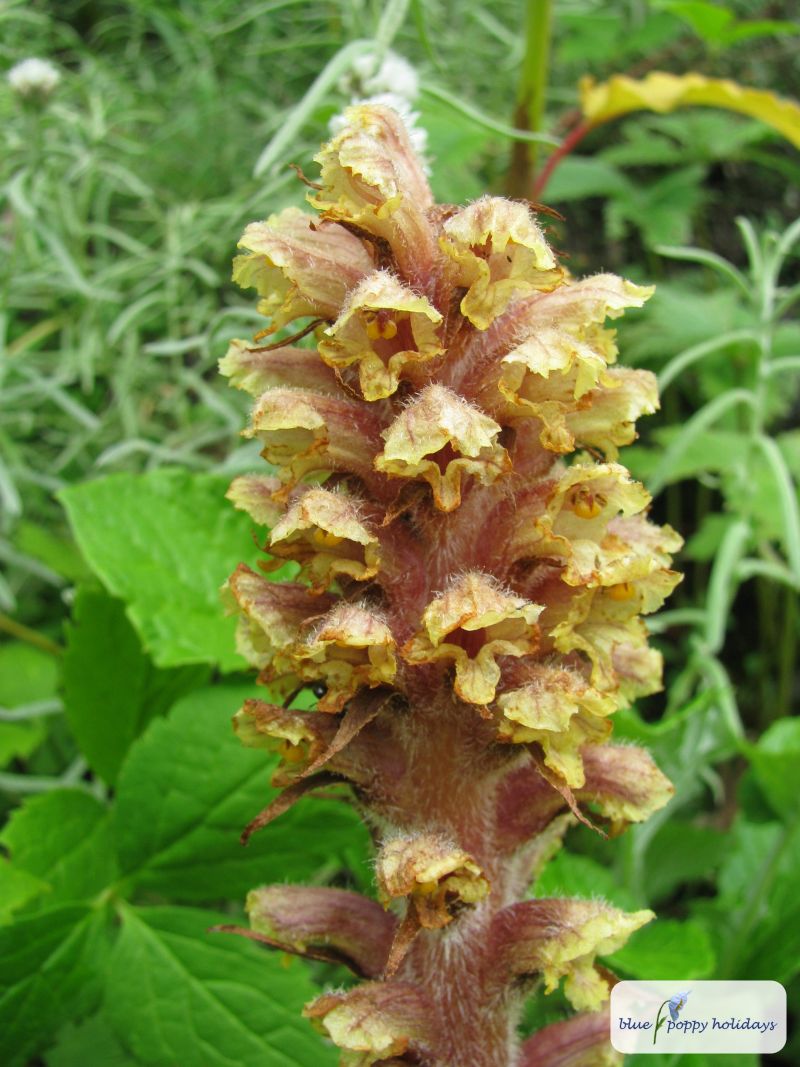
The spike is 30 to 70 cm tall, sturdy, and clothed in small brown or yellowish triangular scales — the vestigial remains of leaves. These scales run all the way up to the flowering head, which carries a dense cluster of two-lipped tubular flowers arranged like small snapdragons. The colour ranges through cream, dull yellow, purple and deep brown, sometimes on the same spike. In flower, the plant has the strange half-organic look of something between a fungus and an orchid.
Its seeds are microscopic — dust-like, produced in the tens of thousands from a single spike — and they can lie dormant in the soil for decades. They germinate only when they detect the specific chemical signal (a group of compounds called strigolactones) released by the roots of a nearby host. The seedling then produces a specialised organ called a haustorium, which pierces the host's root and fuses directly into its vascular tissue — a plumbing connection that will feed the parasite for the rest of its life.
Habitat
Grassy meadows and open slopes where its host, Greater Knapweed (Centaurea scabiosa), grows.
What the name means
Orobanche is a Greek compound — orobos (vetch, or bitter vetch) + anchein (to strangle) — literally "the strangler of vetches", after the ancient Greek observation that these plants suffocated their pulse crops. The species name elatior is Latin for "taller", after the notably tall flowering spike of this species compared with its more modest relatives.
Don't confuse it with
Compare with the three Pedicularis species in this book — P. punctata (sno 66), P. hoffmeisteri (sno 67) and P. porrecta (sno 90) — which belong to the same family Orobanchaceae. Those are only hemi-parasites: they retain green leaves and can photosynthesise, taking only supplementary water and minerals from their hosts. Orobanche elatior has abandoned photosynthesis entirely. The two Cuscuta species here (C. europaea, sno 147; C. reflexa, sno 134) are also full parasites but belong to a different lineage (Convolvulaceae) and drape themselves over the aerial parts of hosts rather than tapping the roots.