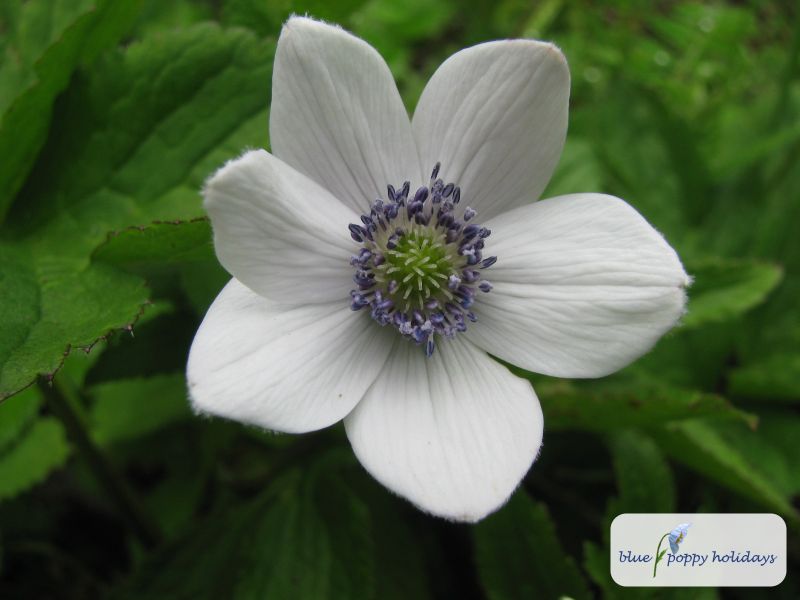
Wildflower of the valley
River Anemone, River Windflower
Anemone rivularis
- Family
- Ranunculaceae (Buttercup family)
- Local name
- Angeli, Mirchilec, Ageli, Charbini, Maruiri
- Type
- Perennial herb
- Height
- up to 1 m
- Altitude
- 2100–4500 m
- Flower colour
- White, tinged blue underneath
- Flowering
- June to September
About River Anemone, River Windflower
Anemone rivularis is a strikingly tall member of a genus better known for small, hugging alpine flowers. It grows as a perennial herb reaching up to a metre in height from a stout, woody rootstock — a stature that gives it the presence of a shrub when seen in flower.
The leaves are hairy throughout. The radical (basal) leaves are 8–35 cm wide and cut into three or five deep lobes, each of which is again divided into three or four segments with sharply toothed margins — a leaf that catches the light like a splayed hand. Higher up the stem the cauline leaves are more finely dissected, breaking into many narrow, palmately arranged lobes; the petioles range from 10 to 35 cm.
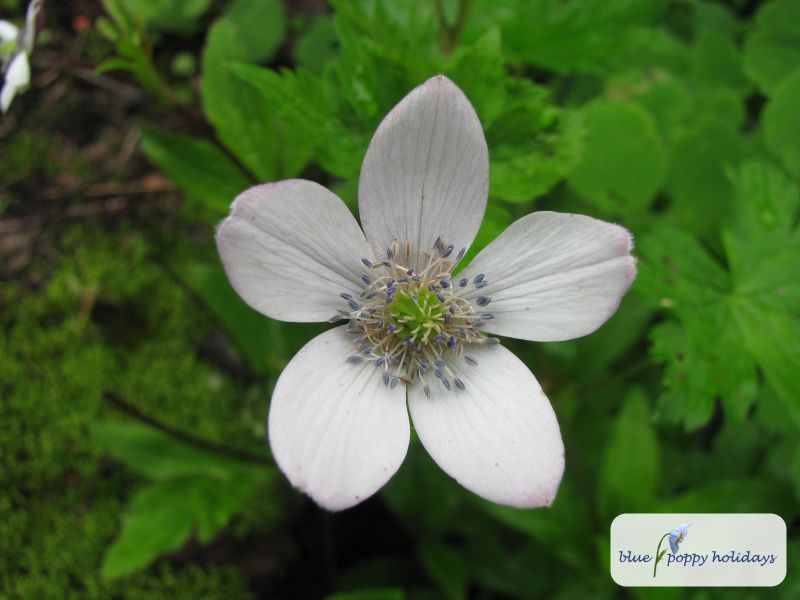
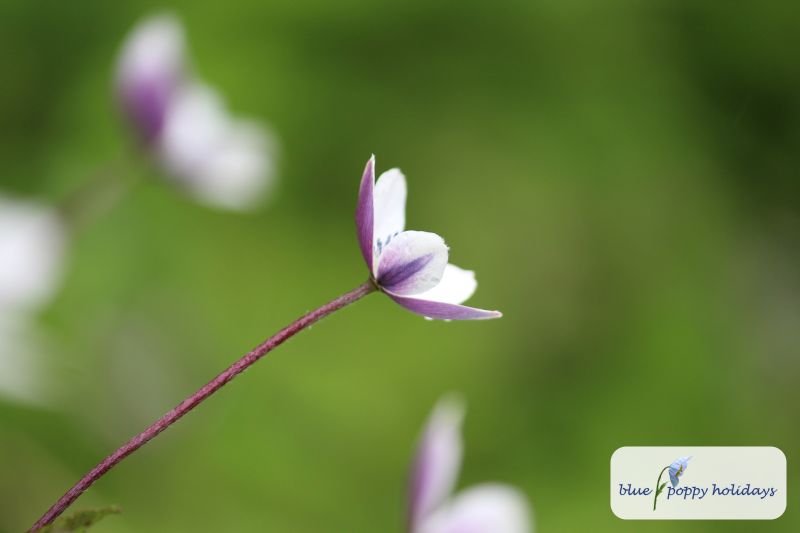
The flowers, 2–4 cm across, sit at the tips of long slender stalks and are gathered into open, branching cymes. Each is pure white on the upper surface but washed with pale blue underneath — a signature of the species, most visible when the flowers nod on the breeze or in early morning before they open fully. What appear to be petals are in fact five to eight petaloid sepals arranged in a single whorl; true petals are absent, replaced in the anemone lineage by unmodified stamens. The many stamens are spirally arranged and carry pale purple or pale blue anthers. The fruit is a smooth achene, hairless, ending in a distinctive hooked beak that gives it grip on passing animal fur.
It thrives, as its name declares, along the margins of streams and rivulets — the constant murmur of moving water is its habitat — and on damp grassy slopes from about 2100 m up to nearly 4500 m. Its range runs across the Himalayan states of India and eastwards through China, Myanmar and Sri Lanka.
Habitat
Along the margins of streams and rivulets, and on damp grassy slopes.
Uses & folklore
The leaves and the small hooked achenes have a long place in the Himalayan pharmacopoeia. A poultice of the crushed leaves is applied to wounds, sores and stubborn headaches; a decoction of the same is drunk for fevers, digestive complaints and the seasonal coughs and colds that accompany the changing monsoon weather. Like most Ranunculaceae, the plant is mildly acrid when fresh — its medicinal use has always relied on careful preparation.
What the name means
Anemone is the classical Greek name for the windflower — from anemos ("wind") — after the fragile blooms that tremble at every breath of air. The species name rivularis is Latin for "of small brooks and rivulets", from rivulus, a diminutive of rivus (stream), naming the plant's constant companion.
Don't confuse it with
Two other anemones grow in the valley: Anemone tetrasepala (sno 6), the Four-petal Anemone, is a shorter plant with only four (rarely five) sepals and blooms earlier, in June and July; Anemone vitifolia (sno 80), the Vine-leaved Anemone, has broader grape-shaped leaves and pink-tinged blooms. A. rivularis is set apart by its impressive stature, the blue underside of its sepals and its faithful preference for the streamside.